Full Mouth Dental Implants vs Dentures: Which Is Right for You?
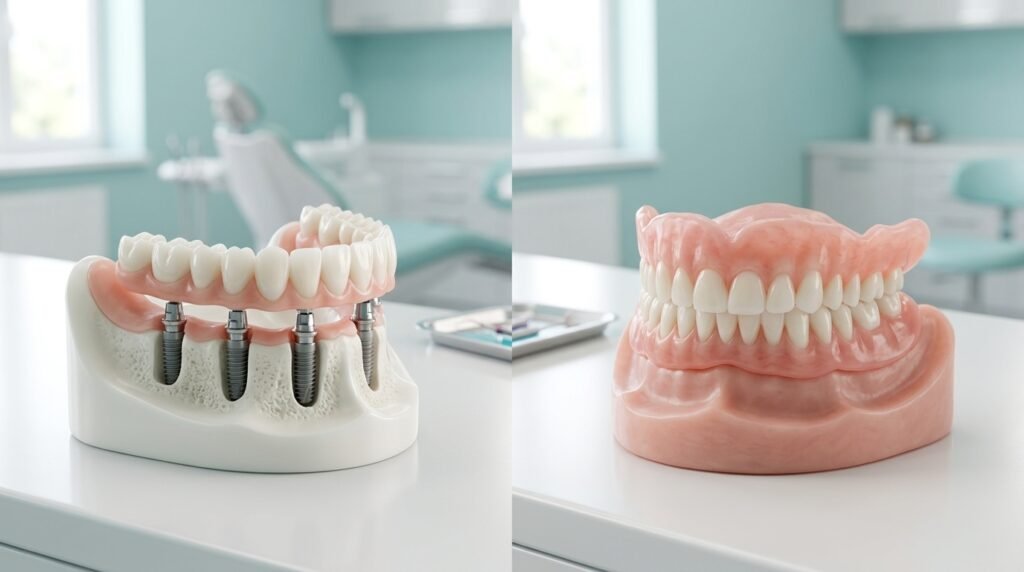
Losing most or all of your teeth is a hard moment, and the choice that follows is just as hard: full mouth dental implants or dentures. Both restore your smile and your ability to eat, but they differ greatly in comfort, long-term results and cost.
Many patients in Karachi arrive at a consultation unsure which route suits them. This guide explains how each option works, compares them side by side, and helps you decide what fits your health, lifestyle and budget. By the end, you will know which questions to ask your dentist before committing.
What Are Full Mouth Dental Implants?
Full mouth dental implants replace an entire arch, or both arches, of missing teeth using small titanium posts placed in the jawbone. Over a few months, the bone fuses with each post in a process called osseointegration, creating a stable foundation that works like natural tooth roots.
You do not need one implant per tooth. Most full-arch treatments use four to six implants per jaw to support a fixed bridge of replacement teeth. Common approaches include the All-on-4 and All-on-6 techniques, which a dental implant specialist selects based on your bone density and bite.
Once healed, the new teeth are fixed in place. You brush them like natural teeth, chew with confidence and never remove them at night.
What Are Dentures?
Dentures are removable replacement teeth made of acrylic, sometimes with a metal framework. A full denture rests on your gums and is held in place by suction, natural adhesion or a dental adhesive. Partial dentures clip onto remaining natural teeth.
They have helped people for generations because they are quick to make, require no surgery and cost less upfront. The trade-off is that they sit on the gums rather than in the bone. Over time the jaw changes shape, so dentures can loosen and need relining, adjusting or replacing every few years.
Full Mouth Dental Implants vs Dentures: Side by Side
| Factor | Full Mouth Dental Implants | Dentures |
| Stability | Fixed in the jaw, no slipping | Can shift when eating or speaking |
| Chewing strength | Close to natural teeth | Reduced, often limits hard foods |
| Bone health | Stimulate the jawbone and help preserve it | Do not stimulate bone, which can shrink over time |
| Appearance | Natural look, no gum-covering plate | Natural when new, may change as the gums reshape |
| Daily care | Brush and floss like natural teeth | Remove, clean and soak every day |
| Lifespan | Often decades with good care | Typically replaced or relined every 5 to 10 years |
| Upfront cost | Higher | Lower |
| Treatment time | Several months including healing | Usually a few weeks |
Comfort and confidence
The biggest daily difference is stability. Denture wearers often worry about slipping while eating, laughing or speaking, and many avoid foods such as apples, steak or nuts. Implant-supported teeth stay put, so meals and conversations feel natural.
Bone health
When teeth are lost, the jawbone slowly shrinks because it no longer receives the pressure of chewing. Implants replace that stimulation, while dentures rest on top of the gums and cannot. Over the years, this is why dentures can start to look and feel looser and why facial structure may change.
The real cost
Dentures cost less at the start, but relines, repairs, adhesives and replacements add up over the years. Implants require a bigger investment initially, yet their long lifespan often makes them the better value over time. Your exact cost depends on the number of implants, the materials used and any preparation such as bone grafting.
Which Option Is Right for You?
Implants may suit you if you:
- Want a permanent, stable solution that feels like natural teeth
- Have enough healthy jawbone, or are open to bone grafting
- Are in good general health and do not smoke, or are willing to quit
- Plan to keep your teeth for decades and prefer a long-term investment
Dentures may suit you if you:
- Need a quicker and lower-cost solution
- Have significant bone loss and prefer to avoid grafting or surgery
- Have a medical condition that makes surgery risky
- Want a temporary option while you save for implants
There is also a middle path. Implant-retained dentures use two to four implants to anchor a removable denture. They are more stable and affordable than a fixed full-arch bridge, and many patients choose them as a compromise. Only an examination with X-rays or a 3D scan can show which option your mouth can support.
What to Expect From Treatment
Full mouth implant treatment follows a clear sequence:
- Consultation and scan: Your dentist examines your mouth, takes X-rays or a 3D scan and plans the number and position of implants.
- Preparation: Damaged teeth are removed, and bone grafting is added if needed.
- Implant placement: The posts are placed under local anaesthesia, with sedation available for anxious patients.
- Healing: Over three to six months, the implants fuse with the bone. A temporary set of teeth is often provided meanwhile.
- Final teeth: Your permanent bridge is fitted and adjusted for comfort and bite.
Dentures are simpler: impressions, a trial fitting and final delivery, usually within a few weeks.
How to Choose the Right Dentist
Full mouth implants are a major procedure, so the clinician matters as much as the technology. Look for a dentist with specific training and a large number of implant cases, modern imaging such as 3D scans, and clear before-and-after examples. Ask about the implant brands used, the warranty, the follow-up schedule and the full cost, including grafting, temporary teeth and final restorations. A good specialist will explain your options honestly, including when dentures are the better choice.
Frequently Asked Questions
Is the implant procedure painful? Placement is done under anaesthesia, so you should feel pressure rather than pain. Mild soreness and swelling for a few days afterwards are normal and manageable with medication.
How long do full mouth implants last? The titanium posts often last decades with good oral hygiene and regular checkups. The teeth on top may need repair or replacement over time.
Can I switch from dentures to implants later? In many cases, yes. A scan will show whether you have enough bone, or whether grafting is needed first.
Final Thoughts
Full mouth dental implants offer the closest experience to natural teeth, with better stability, bone preservation and long-term value. Dentures remain a practical, affordable choice for patients who need a faster or less invasive solution. The right answer depends on your bone health, budget and goals.